Trauma in Lira and Kampala
 It has been nice to be back here working with colleagues. There has been as usual, a fair bit of trauma that we have been dealing with. A day or two after I arrived, there was a large bus accident in the West in Kasese with about 40-50 injured patients, who came to Mulago in waves. There were some 6-10 deaths in this crash. Many of those who were injured had soft tissue, orthopedic, and head injuries. We cared for a patient who unfortunately suffered a low cervical spine injury with resulting paraplegia, then progressive quadriplegia, and she was unable to be supported through the week. Cervical collars are very hard to find and prohibitively expensive for most families. Many of the families involved in the crash had multiple victims within their families.
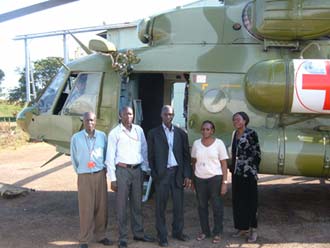
Just the next week, there was another major bus crash in Lira in the north. An overloaded truck with about 130 people overturned with 6-8 casualties on the scene. Those who survived showed up in waves at the two main hospitals in the region, one the regional hospital in Lira, and a private mission hospital. The Ministry of Health was asked to send a team with extra supplies to care for the injured, to help evaluate critically ill or multiply injured patients, and to evacuate those who needed a higher level of care. A team led by Dr. Jackie Mabweijano went to Lira on January 16th with assistance from a medical helicopter provided by the military. The team also comprised Dr. Waiswa of the Department of Orthopedics, a physician from the Ministry of Health, and I also joined on this trip.
It has been nice to be back here working with colleagues. There has been as usual, a fair bit of trauma that we have been dealing with. A day or two after I arrived, there was a large bus accident in the West in Kasese with about 40-50 injured patients, who came to Mulago in waves. There were some 6-10 deaths in this crash. Many of those who were injured had soft tissue, orthopedic, and head injuries. We cared for a patient who unfortunately suffered a low cervical spine injury with resulting paraplegia, then progressive quadriplegia, and she was unable to be supported through the week. Cervical collars are very hard to find and prohibitively expensive for most families. Many of the families involved in the crash had multiple victims within their families.
Just the next week, there was another major bus crash in Lira in the north. An overloaded truck with about 130 people overturned with 6-8 casualties on the scene. Those who survived showed up in waves at the two main hospitals in the region, one the regional hospital in Lira, and a private mission hospital. The Ministry of Health was asked to send a team with extra supplies to care for the injured, to help evaluate critically ill or multiply injured patients, and to evacuate those who needed a higher level of care. A team led by Dr. Jackie Mabweijano went to Lira on January 16th with assistance from a medical helicopter provided by the military. The team also comprised Dr. Waiswa of the Department of Orthopedics, a physician from the Ministry of Health, and I also joined on this trip.
 We first picked up supplies requested by the Lira Hospital from the Joint Medical Stores in Entebbe before heading to Lira by helicopter, about a one hour and a half ride. We were greeted by a group of local government and hospital officials who were clearly still reeling from the incident. They were tremendously thankful for the support. Apparently all 130 casualties showed up in waves at the hospitals. The truck had been headed back from a very large (20,000+ persons) church gathering. The Lira Hospital had two specialist surgeons and several medical officers to deal with the injuries. The hospital staff were exhausted having worked continuously since the crash. We were generally impressed with the attention and triage the patients had received given the environment of limited resources (ie one operating room, one X ray machine). They unfortunately lost a patient just before our arrival who suffered a cervical spine injury. Many of the patients had severe soft-tissue injuries. We took five patients back to Kampala by helicopter ranging in age from one to forty. There were several patients with combinations of longbone fractures and head injuries, along with severe soft tissue injuries.
The crash highlights the carnage on the roads that continues to be a major neglected epidemic in the developing world, with many unsafe vehicles overloaded with passengers contributing to the problem. Many of these incidents don't make the news or are buried and forgotten, especially compared to the international attention provided to infectious diseases.
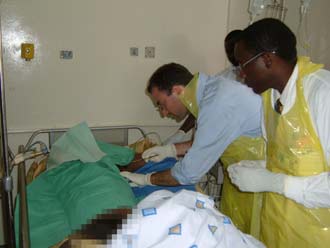
Then a few days later seven Ugandan patients were burned in Juba, southern Sudan, in a housefire, and evacuated to Mulago Hospital for further care. Unfortunately, one patient with 100% burns could not be resuscitated on arrival due to severity of injury. Two patients arrived with no cutaneous burns but had signs of severe inhalation injury and required immediate intubation. They were subsequently sedated and ventilated in the ICU and fortunately have been recently extubated and are generally revering well. It seems this may be the first time that patients that suffered from such severe airway injuries from burns were able to survive due to effective critical care. Patients were initially sedated with propofol then on a midazolam drip as the propofol supply was exhausted. They were able to be nutritionally supported through soft food through an NG Tube. It is a testament to the ICU and critical care-anesthesia staff that these patients have done as well as they have. Especially given the great shortage of personnel in the country trained in anesthesia and critical care.
We first picked up supplies requested by the Lira Hospital from the Joint Medical Stores in Entebbe before heading to Lira by helicopter, about a one hour and a half ride. We were greeted by a group of local government and hospital officials who were clearly still reeling from the incident. They were tremendously thankful for the support. Apparently all 130 casualties showed up in waves at the hospitals. The truck had been headed back from a very large (20,000+ persons) church gathering. The Lira Hospital had two specialist surgeons and several medical officers to deal with the injuries. The hospital staff were exhausted having worked continuously since the crash. We were generally impressed with the attention and triage the patients had received given the environment of limited resources (ie one operating room, one X ray machine). They unfortunately lost a patient just before our arrival who suffered a cervical spine injury. Many of the patients had severe soft-tissue injuries. We took five patients back to Kampala by helicopter ranging in age from one to forty. There were several patients with combinations of longbone fractures and head injuries, along with severe soft tissue injuries.
The crash highlights the carnage on the roads that continues to be a major neglected epidemic in the developing world, with many unsafe vehicles overloaded with passengers contributing to the problem. Many of these incidents don't make the news or are buried and forgotten, especially compared to the international attention provided to infectious diseases.
Then a few days later seven Ugandan patients were burned in Juba, southern Sudan, in a housefire, and evacuated to Mulago Hospital for further care. Unfortunately, one patient with 100% burns could not be resuscitated on arrival due to severity of injury. Two patients arrived with no cutaneous burns but had signs of severe inhalation injury and required immediate intubation. They were subsequently sedated and ventilated in the ICU and fortunately have been recently extubated and are generally revering well. It seems this may be the first time that patients that suffered from such severe airway injuries from burns were able to survive due to effective critical care. Patients were initially sedated with propofol then on a midazolam drip as the propofol supply was exhausted. They were able to be nutritionally supported through soft food through an NG Tube. It is a testament to the ICU and critical care-anesthesia staff that these patients have done as well as they have. Especially given the great shortage of personnel in the country trained in anesthesia and critical care.
posted by Doruk Ozgediz at
1/31/2008


0 Comments:
Post a Comment
<< Home